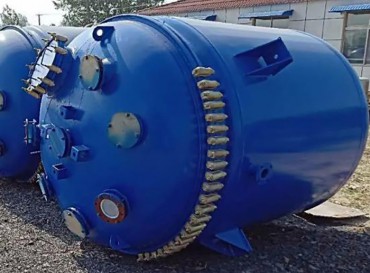
In modern industrial fields such as chemical,pharmaceutical,pesticide,dye,etc.,it is often necessary to handle highly corrosive media.Under these demanding process conditions,a device that combines metal strength and glass corrosion resistance-the enamel glass reactor-has become an indispensable key equipment.It is like a steel warrior wearing"glass armor",guarding the safety and purity of production with its unique structural design and scientific principles.
1.What is a glass lined reaction vessel
The enamel reaction vessel,commonly known as the"enamel reaction vessel"or"enamel can",is a reaction equipment that sprays a high silicon content enamel slurry onto the surface of a carbon steel or cast iron vessel,and after being fired at a high temperature of nearly 1000℃,the enamel is firmly adhered to the metal substrate,forming a hard,smooth,and transparent inorganic glass coating.
The advantages of metal matrix include high mechanical strength,pressure resistance,heat resistance,and good thermal conductivity.
The advantages of glass coating:excellent chemical stability,resistance to strong acids,alkalis,and organic solvents,smooth surface,not easy to hang materials,and easy to clean.
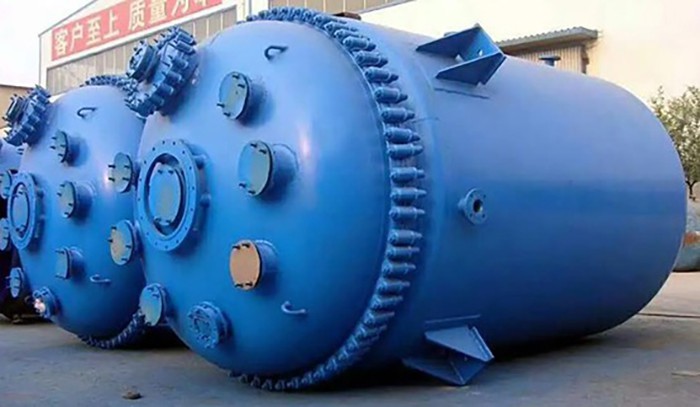
2.Detailed structural analysis of enamel glass lined reactor
A standard
glass lined reactor can be seen as a system consisting of the following core components:
1.Cauldron body
Structure:Usually welded from carbon steel plates,it is the pressure bearing body of the equipment.
Inner surface:After sandblasting and rust removal,it is enamel fired to form a uniform enamel glass lining.This is the core area where materials come into direct contact and undergo reactions.
Jacket:another shell wrapped around the outer layer of the kettle,forming a closed space with the outer wall of the kettle.A jacket is a channel for heat exchange,through which steam,hot water,or coolant is introduced to heat or cool the materials inside the kettle.
2.Cauldron cover
Structure:Similar to the kettle body,it is also a carbon steel body with a jacket,and the inner surface is coated with glass.
Openings and accessories:There are multiple standardized openings on the kettle cover for installing various accessories,forming the"five senses"and"four limbs"of the equipment,including:
Manhole:used for personnel to enter the interior of equipment for maintenance and cleaning.
Feeding port:used for feeding solid or liquid materials.
Mirror:used to observe the reaction and liquid level of the materials inside the kettle.
Thermowell:Install temperature sensors to monitor material temperature in real-time.
Backup port:pH meter,pressure gauge,etc.can be installed according to process requirements.
3.Mixing system
Function:To evenly mix materials,enhance heat and mass transfer,and promote chemical reactions.
form:
Blender:usually anchor,paddle,or impeller type,with a metal shaft covered with a enamel layer and blades made of enamel material.
Mechanical seal:located between the mixing shaft and the kettle cover,it is a key component to prevent material leakage,requiring high precision,high wear resistance,and corrosion resistance.
4.Transmission device
Composition:including motor,reducer,etc.
Function:Provide power for the mixing system and control the mixing speed and torque.
5.Discharge valve
Location:Located at the bottom of the kettle body.
Function:Used to discharge the material after the reaction is completed.The parts inside the valve that come into contact with the material are also treated with enamel to ensure that there are no corrosion dead corners in the entire process.
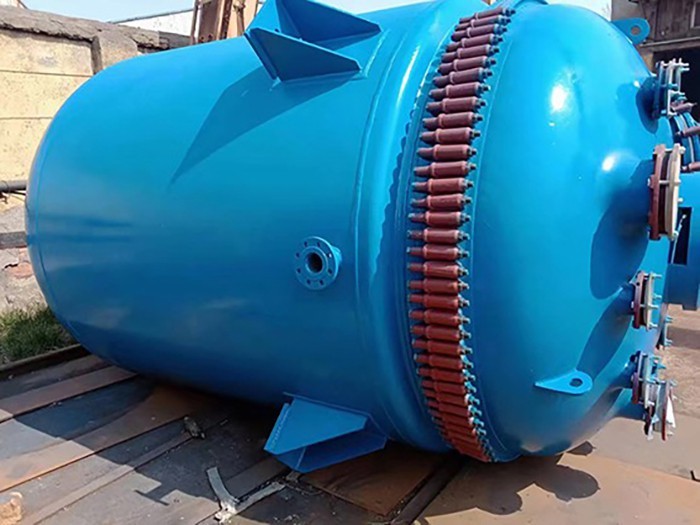
3.Working principle of enamel glass reactor
The working principle of a glass lined reactor can be understood as the combination of the functions of a"physical container"and a"chemical reactor".
1.As a physical container:providing reaction space and conditions
Material containment:Its sturdy kettle body provides a sealed space that can withstand a certain pressure,used to hold reaction materials.
Heat exchange:By circulating a thermal conductive medium inside the jacket,the temperature and cooling of the materials inside the kettle are achieved,creating the necessary temperature environment for endothermic or exothermic reactions.
Material mixing:By rotating the mixer,the material is effectively mixed,emulsified,or suspended to ensure uniform and thorough reaction.
2.As a chemical reactor:the core of realizing chemical processes
Corrosion resistance protection:This is its core function.When corrosive materials such as strong acids and alkalis react in the kettle,the hard enamel layer acts as a barrier,completely isolating the corrosive substances from the fragile metal substrate,preventing equipment from being corroded and perforated,and also avoiding metal ion contamination of the product.
Surface smoothness:The glass surface is smooth and not easily adhered to materials,which not only facilitates cleaning and prevents cross contamination between batches,but also reduces losses caused by material residue.
4.Unique"enamel burning"principle-the combination of metal and glass
The key to the success of enamel glass equipment lies in the"tight adhesion"formed between the porcelain glaze and the metal steel plate during the high-temperature firing process.
At a firing temperature of around 900℃,the surface of the steel plate will undergo oxidation,forming a layer of iron oxide film.At the same time,the porcelain glaze melts and penetrates into this oxide film.During the cooling process,the thermal expansion coefficients between the enamel,iron oxide layer,and steel substrate match each other,resulting in strong compressive stress at the bonding interface,thus forming a strong bonding layer that combines chemical bonds and mechanical forces.This'tight'strength is the foundation for enamel glass equipment to withstand mechanical and thermal impacts without peeling off.
In summary,the enamel glass reactor,with its unique"steel reinforced glass core"structure and the principle of combining physical containment with chemical protection,has become a powerful tool for combating corrosion in modern process industries.Understanding its structure and principles is fundamental to the proper use and maintenance of this critical equipment,ensuring its long-term stable operation.
 Address:Zibo City, Shandong Province
 WhatsApp:+8615653328535
 Wechat: +8615965331535
  E-mail:zs@sdsmachinery.com